
 Share on Bluesky
 Share on X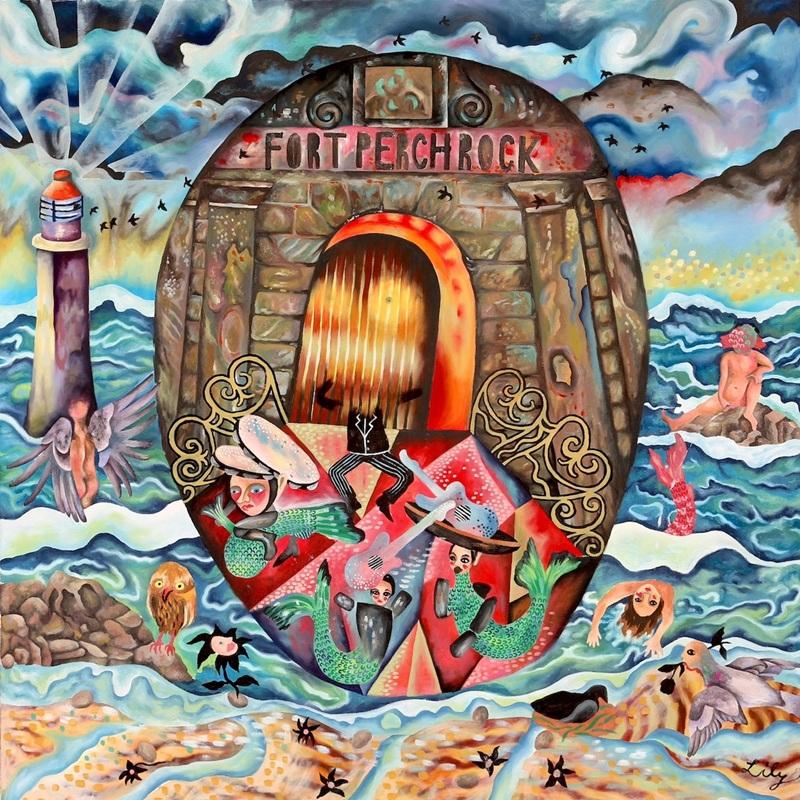

‘Fort Perch Rock’ is a giant leap forward for The Dream Machine, because the quintet have fully embraced the touchstones of psychedelia and garage rock.
We’re nice here so we won’t do spoilers for Angel Heart, the infamous 1987 voodoo horror movie starring Mickey Rourke and Robert De Niro.
Without giving the ending away, one of the final scenes has Rourke – playing a New York private detective called Johnny Favorite – looking deep into a mirror before repeating the phrase, ‘I know who I am’, as he realizes he might have just lost the ultimate game.

Knowing who you are isn’t always a linear journey, one that citizens of the Wirral – the oblong bit across the Mersey from Liverpool – have often had to sign up for themselves.
To most of geographically challenged Britain, the two places are indistinct, but under the microscope things can be different.
Proud of their own heritage, Wiralites point to Orchestral Manoeuvres In The Dark, The Boo Radleys and The Coral as local outfits done good on both sides of the water.
For New Brightonians The Dream Machine postcodes shouldn’t matter, but their sure-to-be breakout third album is named after a fort on the peninsula, whilst its 2024 predecessor Small Time Monsters was produced by The Coral’s James Skelly.
If that was long on whimsy and a bit too lightweight for its own good, Fort Perch Rock is a giant leap forward, not least of which because the quintet, led by singer Zak McDonnell, on it have fully embraced the touchstones of psychedelia and garage rock to great effect.
It’s an inspired decision, acknowledging Merseyside’s (let’s all stay friends here) unique perspective on a musical era which was essayed so thoroughly by a post-Teardrop Explodes Julian Cope in 1983.
Cope referenced Lenny Kaye’s seminal 1972 compilation Nuggets – then languishing in obscurity – and Fort Perch Rock’s titular opener doubles down on the groovy, primal rock ground out by many of the bands which populate it.
No sooner has that exited stage left than Flowers On The Razor Wire shifts tack immediately the words inspired, McDonnell says, by an erotic graphic novel, whilst the band mutate into territory occupied by The Walkmen.
Not content with inertia, the sad-happy ode to our now perpetual worst of times Things That Make Us Cry is a boss attempt to emulate Phil Spector’s wall of sound, the vibes provided courtesy of a slightly out of tune piano and a skip-salvaged kettle drum.
You don’t always need reclaimed instruments to create music some people would call classic though – often attitude is 90 percent of that journey.
Armed with this wisdom, Julie On The Rocks rides high on a surf-ish guitar line and spectral keys, whilst the hammering rawness of Duck Bone Fever – all Nuggets menace and head expanding groove – is just made for tuning in and dropping out.
If you dig that you’ll LOVE The First Bird, which in clocking in at over 8 minutes is by far the most ambitious pigeon to be let out of the album’s coop. I
n form a similar meditation-friendly jam to that strung out by the early Verve (and by extension, The Doors), on it McDonnell tremulously steers what can be steered, eventually leaving this mortal realm for unknown space.
Gentle acoustic closer Best Days Of Our Lives closes things positively but, inspired by the words of Johnny himself, Angel Heart brings Fort Perch Rock back full circle to matters of identity and its truth.
The Dream Machine know who they are – and now, who they’re not.
Fort Perch Rock comes from whatever piece of dirt you want it to, a record which will put them on a map without lines or names, one showing only infinite potential.
Related news:
 Fine Young Cannibals – FYC 40: Album Review
 Happy Mondays – The Factory Singles: Album Review
 Joanna – Hello Flower: Album Review
 Megadeth – Megadeth: Album Review
 James Adrian Brown – Forever Neon Lights: Album Review
 Lucinda Williams – World’s Gone Wrong: Album Review
 Daphni – Butterfly: Album Review
 Converge – Love Is Not Enough: Album Review