
 Share on Bluesky
 Share on X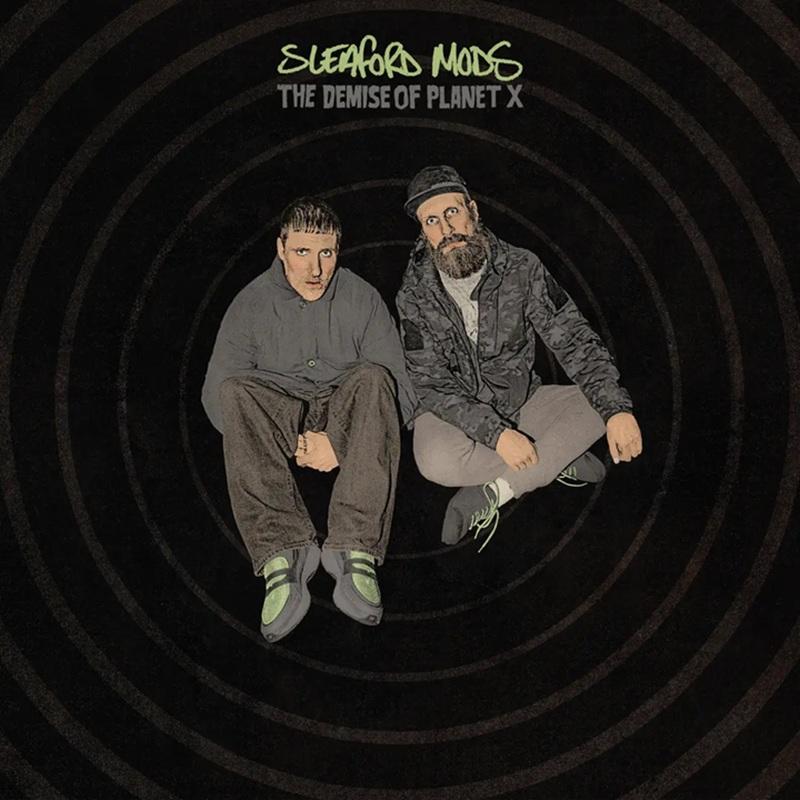

Rewarding repeat listens, The Demise Of Planet X is bristling with detail and finds Sleaford Mods at their most evocative.
And they thought things were bad when they started out.
Who better to soundtrack the seemingly inevitable erosion of the UK’s spirit than Sleaford Mods?

The Demise Of Planet X sees Jason Williamson and Andrew Fearn confronting grim times by sharpening, rather than dulling, their creative edge.
Their ninth album together features more guests, textures and exposed vulnerability than any previous record, slightly nudging them into unfamiliar but fertile terrain.
The Good Life immediately stakes out that restlessness, with Gwendoline Christie’s terrifying laugh announcing the unease of life and ushering in a three-character psychodrama played out within a single psyche: Williamson’s own.
Big Special’s warm chorus offers a vision of happiness and calm while the lyricist’s trademark fast-paced fury circles it like a saboteur.
Christie arrives as a new internal, unhinged voice, revelling in the compulsion to slag everything off, be it bands, scenes, or himself.
Drawing on recent therapy and self-scrutiny, Williamson frames cruelty as both an outward habit and inward weapon. It’s a mood-swinging manifesto that lulls you into serenity before yanking the rug away.
Double Diamond resurrects an old pre-Fearn lyric, its teasing guitar abruptly cut short before settling into a desolate plod.
Rebuilt yet transformed by Fearn’s arrangement, it sounds like a murky morning-after dispatch from the bottle’s bottom.
But with dark there must be light, and Elitist G.O.A.T. is a near-euphoric pop detour, Aldous Harding’s calming presence softening Williamson’s barbs without blunting them.
With both a soft centre and a sting in the tail, its sci-fi one-liners mask a critique of cultural elitism.
Similarly, No Touch wraps a drug-use confessional in scratchy percussion and Sue Tompkins’ child-like, distracted delivery, innocence and murkiness slipping across each other uncomfortably.
Classic Sleaford Mods bile resurfaces on Megaton, driven by a flabby bass lick and righteous anger. It skewers the fragmentation of social media, where trauma, guilt and performative righteousness curdle into alienation.
Williamson’s gaze then drifts to delightful tour-room minutiae (press-ups, masturbation, misplaced social posts) as if the world collapses quietly offscreen while we argue about where to upload the evidence.
The album’s most textured moment arrives with Bad Santa, a brooding, sophisticated dismantling of alpha-male culture, Trumpian menace and the aggressive policing of other people’s lives.
Its sonics consciously undermine the aggression it observes, weaving political threat together with pettier violence. While not overhauling their formula, Fearn continues to tweak and push the boundaries of their sound.
The title-track brilliantly usurps the Magic Roundabout theme, aligning flippancy with depression in what may be the most Sleaford Mods song yet.
English cultural stasis, Shirley Valentine allegory and Grantham nightclub mythology collide in a delirious reworking of what its author describes as UK Grim: the Shirley Valentine years.
Gina Was forms the album’s narrative centrepiece as Williamson revisits a childhood incident with unsettling clarity.
Without going into details, the incident is the origin story for The Maggot Man, a representation of his anxiety, who appears at several points across the album.
Elsewhere, Shoving The Images skewers hollow online activism with glistening spookiness, while Flood The Zone (an expression always destined to become a Sleaford Mods tracks), featuring Liam Bailey, takes its title from Steve Bannon’s strategy of deliberate confusion.
Kill List dives into dystopian treble-heavy rage, while closer The Unwrap pulls back the curtain entirely: after all the arguments and end-times rhetoric, Williamson is still just at home, ordering things online, waiting for the doorbell and his dopamine hit.
Rewarding repeat listens, The Demise Of Planet X is bristling with detail (vocoders, whomping beats, wind chimes) and finds Sleaford Mods at their most evocative.
Like human beings themselves, it’s full of contradictions, humour and despair, treating societal collapse not as a full stop but as a volatile creative spark.

Related news:
 The Clause – Victim Of A Casual Thing: Album Review
 Various Artists – Killed By Deaf (A Punk Tribute To Motorhead): Album Review
 Daniel Avery – Tremor: Album Review
 Stella Donnelly – Love And Fortune: Album Review
 Adult DVD, VLURE and more at Simple Things 2025: Live Review
 Iona Zajac – Bang: Album Review
 Happy Mondays – The Factory Singles: Album Review
 Babyshambles live at Bristol O2 Academy: Gig Review